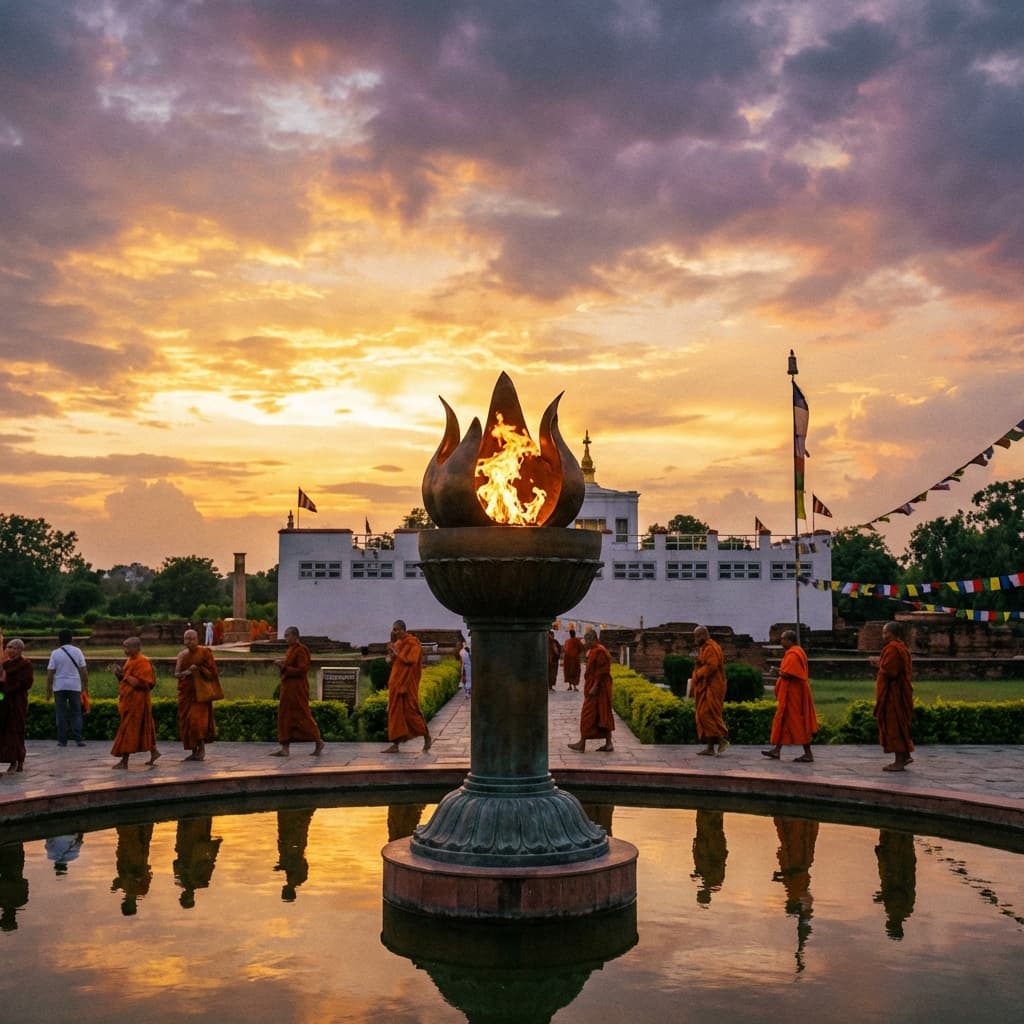
Lumbini, located in the Terai plains of Nepal, is one of the most sacred places on Earth. As the birthplace of Siddhartha Gautama — who became the Buddha approximately 2,600 years ago — it is both a UNESCO World Heritage Site and one of the four holiest pilgrimage sites in the Buddhist world. Each year, hundreds of thousands of pilgrims and travellers from across Asia and beyond come to stand on the ground where one of history's most transformative figures first entered the world.
Why Visit Lumbini?
| Key Detail | Information |
|---|---|
| UNESCO Status | World Heritage Site since 1997 |
| Location | Rupandehi District, Lumbini Province, Nepal |
| Distance from Kathmandu | ~280km (5–6 hrs by tourist bus or 30-min flight to Bhairahawa) |
| Distance from Pokhara | ~180km (~4 hrs) |
| Recommended Duration | 1–2 full days |
| Best Time to Visit | October to March |
Lumbini is not merely a religious site — it is an extraordinary archaeological and architectural destination. The Lumbini Development Trust master plan, designed by Japanese architect Kenzo Tange, has created a unique pilgrimage city where temples and monasteries built by countries and orders from around the world coexist with ancient remains in a beautifully landscaped park setting.
The Sacred Garden: Where the Buddha Was Born
The heart of Lumbini is the Sacred Garden — the original birthplace site containing the most important archaeological and historical remains.
Maya Devi Temple
The most important structure in all of Lumbini. The existing brick temple shelters the exact spot where Queen Maya Devi gave birth to Siddhartha Gautama in 623 BC (traditional dating). Inside, you can see:
- The Marker Stone: The precise birth spot, protected under the temple
- The Nativity Sculpture: A carved panel showing Maya Devi holding a branch of a Sal tree, with the infant Buddha standing on a lotus — one of the most iconic images in Buddhist art
Entry to the inner sanctum requires removing shoes and maintaining silence. Photography restrictions apply inside the temple itself.
The Ashoka Pillar
Erected by the Mauryan Emperor Ashoka in 249 BC — the oldest surviving stone inscription in Nepal. The pillar bears an inscription in Brahmi script that reads (translated): "Here the Buddha, sage of the Shakyas, was born." This single inscription is the primary historical confirmation that Lumbini is indeed the Buddha's birthplace. The pillar stands 7.2m tall in its current form (the top is broken).
The Holy Pond (Puskarni)
A sacred rectangular pool where, according to tradition, Queen Maya Devi bathed before giving birth and where the infant Buddha was first bathed. The pond is surrounded by ancient brick remains and is a place of quiet reflection.
The Sacred Bodhi Tree
A descendant of the original Bodhi Tree under which the Buddha is said to have been born. Pilgrims tie prayer flags and offerings to its branches.
The Monastic Zone
Radiating outward from the Sacred Garden along a 2km-long central canal is the Lumbini Monastic Zone — a masterplanned area divided into two sections:
East Zone: Theravada (South Asian and Southeast Asian) Monasteries
Built by Sri Lanka, Myanmar, Thailand, Cambodia, and India:
- Royal Thai Monastery: An opulent white marble structure with intricate ornamentation
- Myanmar Monastery: Features traditional Myanmar pagoda architecture
- Sri Lanka Monastery: Surrounded by a beautiful garden reflecting Sri Lankan temple aesthetics
West Zone: Mahayana and Vajrayana Monasteries
Built by China, Japan, Korea, Germany, Nepal, and Tibet:
- Great Drigung Kagyud Lotus Stupa (Nepal): A stunning cylindrical stupa representing the Tibetan Buddhist tradition
- Chinese Monastery: A grand multi-storey pagoda complex
- German Monastery (Lokamani Pula Meditation Centre): Known for outstanding murals and meditation facilities
- Korean Temple: A beautifully proportioned traditional Korean courtyard temple
Each monastery is active — monks live and practice here — making Lumbini a living centre of global Buddhism rather than merely a museum.
The World Peace Pagoda
Located south of the Sacred Garden, the Shanti Stupa (World Peace Pagoda) was built by Japanese Buddhist monks of the Nipponzan-Myohoji order. The brilliant white structure stands 41m tall and houses relics of the Buddha donated by Sri Lanka and India. The stupa is visible from kilometres around and offers panoramic views of the surrounding Terai plains.
Birdwatching in Lumbini
Lumbini's wetlands and forest areas support exceptional birdlife:
- Sarus Crane: The world's tallest flying bird, considered sacred in local tradition
- Greater Spotted Eagle: A rare migrant passing through the Terai corridor
- Indian Roller, Peacock, Painted Stork
- Over 200 bird species recorded in the Lumbini zone
How to Get to Lumbini
By Air
The nearest airport is Gautam Buddha International Airport (Bhairahawa/Siddharthanagar) — approximately 22km from the Sacred Garden. Direct flights from Kathmandu take approximately 30 minutes (several daily). A taxi from Bhairahawa airport to Lumbini costs approximately NPR 1,000–1,500.
By Tourist Bus (from Kathmandu)
Several tourist bus services run overnight from Kathmandu to Bhairahawa (8–9 hrs, from ~USD 12). From Bhairahawa, take a local bus or taxi to Lumbini (45 minutes).
By Tourist Bus (from Pokhara)
Buses and shared jeeps run from Pokhara to Bhairahawa (4 hrs) or direct to Lumbini via local transport.
Within Lumbini
The monastic zone is best explored by bicycle (rentals available from ~NPR 200/day) or on foot. Electric vehicles are also available for hire within the park.
Where to Stay in Lumbini
| Category | Options & Price Range |
|---|---|
| Budget | Guesthouses near the Sacred Garden — from USD 10–25/night |
| Mid-range | Lumbini Garden Lodge, Hotel Kasturimayi — USD 35–70/night |
| Luxury | Lumbini Buddha Garden Resort — USD 100+/night |
Most accommodation is clustered in the Lumbini Bazaar area, a short walk or cycle from the Sacred Garden.
Best Time to Visit Lumbini
October to March ✅ Recommended
- Cool, dry weather — ideal for walking the monastic zone
- Buddha Jayanti (May): The most significant festival, attracting thousands — book early
- Lowest temperatures in December–January (10–15°C) — comfortable for sightseeing
April–May ⚠️
- Hot and increasingly humid before the monsoon
- Vesak/Buddha Purnima celebrations make May the most spiritually significant month but also the busiest
June–September (Monsoon) ⚠️
- High heat and humidity (35°C+)
- Significant rainfall
- Not ideal for extended outdoor exploration, though the gardens are green and atmospheric
Practical Tips for Visiting Lumbini
- Dress respectfully: Modest, covered clothing is expected in the Sacred Garden and monastery areas
- Shoes off: Required at the Maya Devi Temple and inside most monasteries
- Photography: Permitted in most areas but restricted inside some temple interiors
- Entry: The Sacred Garden has a modest entrance fee (NPR 300 for foreigners as of 2025)
- Silence and behaviour: The Sacred Garden is a place of active worship — maintain silence and respect meditation in progress
- Money exchange: ATMs are available in Lumbini Bazaar; carry some cash for small purchases
Frequently Asked Questions
Is Lumbini worth visiting for non-Buddhist travellers? Absolutely. It is an archaeological and architectural experience of the highest order, and the sense of peaceful atmosphere in the Sacred Garden is remarkable regardless of one's faith.
How much time should I spend in Lumbini? A minimum of one full day to see the Sacred Garden and the main monasteries. Two days allows the full monastic zone and the World Peace Pagoda at a comfortable pace.
Can I combine Lumbini with Chitwan National Park? Yes — Bhairahawa (Lumbini) to Chitwan (Sauraha) takes approximately 3 hours by road. Many travellers combine these two highlights of the Nepal Terai.
Lumbini is one of the few places on Earth where history, faith, and landscape converge in a way that is genuinely moving regardless of your reasons for visiting. It should be on every Nepal itinerary, not as an afterthought, but as a destination in its own right.